
The Myth of Artistic Solitude: A Day Painting at Mount Rainier
Clouds, Crowds, and Watercolors in Mount Rainier National Park.
What would you imagine if I told you I’d just spent the day painting the vistas at Mount Rainier National Park? Would you envision me hiking miles into the backcountry, setting up my easel on a high, windswept ridge, amidst wildflowers and a mist-shrouded forest? Communing serenely with nature as I documented the majesty of the mountain brushstroke by reverent brushstroke?
What a beautiful, romantic scene!
That absolutely did not happen.
The Best Laid Plans…
Let me start at the beginning, before sunrise on a Sunday morning in late summer, driving up to Paradise at the south slope of Mount Rainier. An area famous for the historic Paradise Inn lodge, picturesque alpine meadows, stunning closeup views of the glaciers and the mountain’s summit, and easy access to the most popular trails.
A lingering injury meant I was not going to be escaping into the wilderness or hiking any trails, especially not while hauling my easel and chair and art supplies. My only opportunity to see The Mountain was going to be from the paved, accessible areas around the visitor center, a short walk from a hard-won parking spot. Even though it was still early, the park was already very busy.
The view of the mountain from the trailhead is incredible. Even the trailhead itself is a postcard-worthy scene—a wide staircase leads up through the flower-dotted meadow below the mountain, inviting you to venture forth into the wilderness. While I was grieving that I wouldn’t get to go for a hike, I had to appreciate how gorgeous the accessible area was. It’s really wonderful that the park offers everyone this close-up experience! However, my dreamy vision of a tranquil, one-day, self-determined national park art residency was continuing to fade.
Setting the Scenes
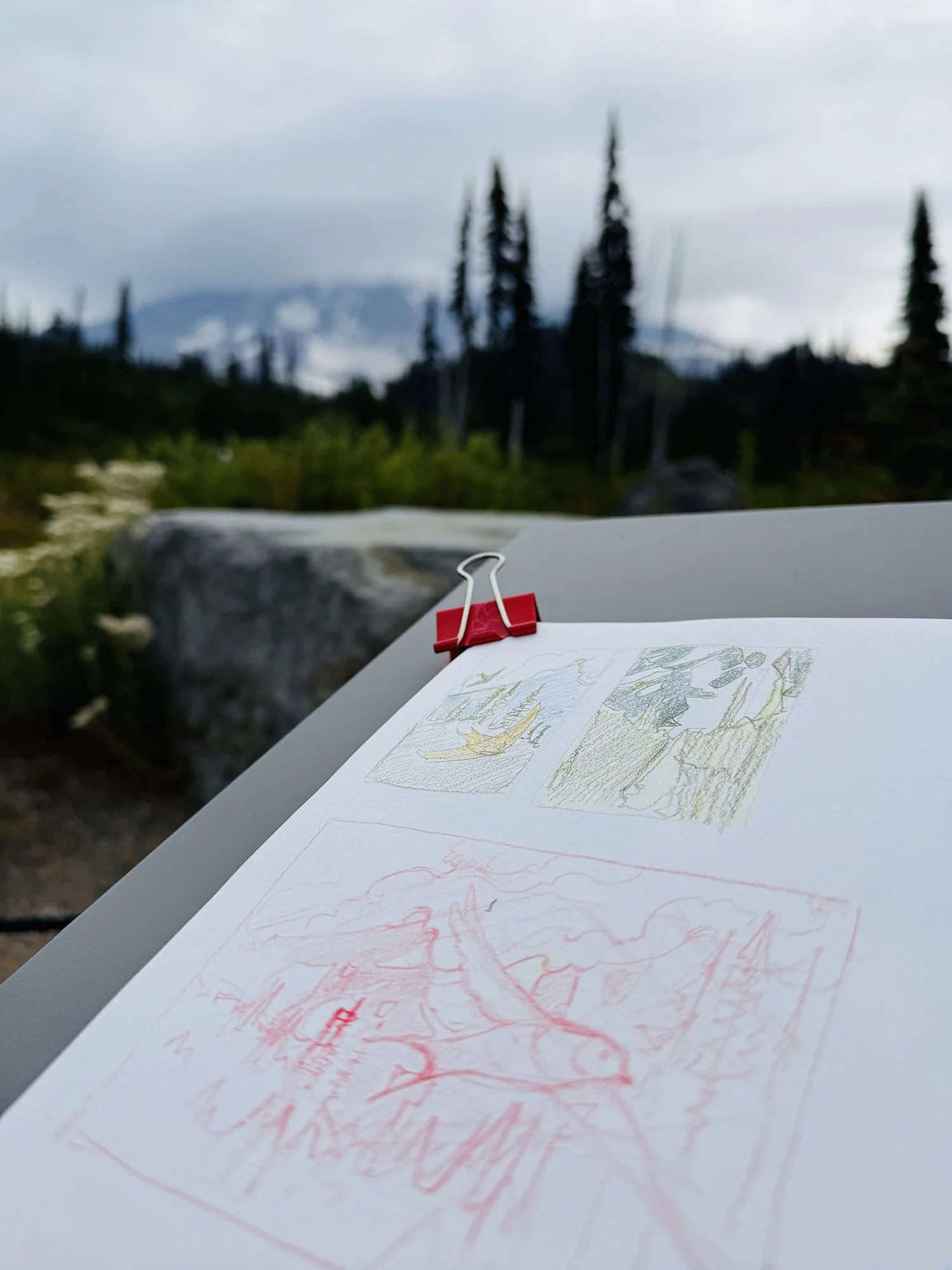
I set up my folding camp chair and opened my sketchbook to warm up with some quick pencil sketches. The chilly, misty weather was a nice break from the heat back home, but I was hoping the fog and clouds would soon lift and reveal the mountaintop.
I spent my morning taking it all in. I sketched the wildflowers growing nearby. I studied the atmospheric colors of the mountain and traced the shapes of glaciers among the slopes. While I was drawing, a barn swallow flew straight at me, diving so low I feared a collision, and earned itself a starring role in one of my concept sketches.
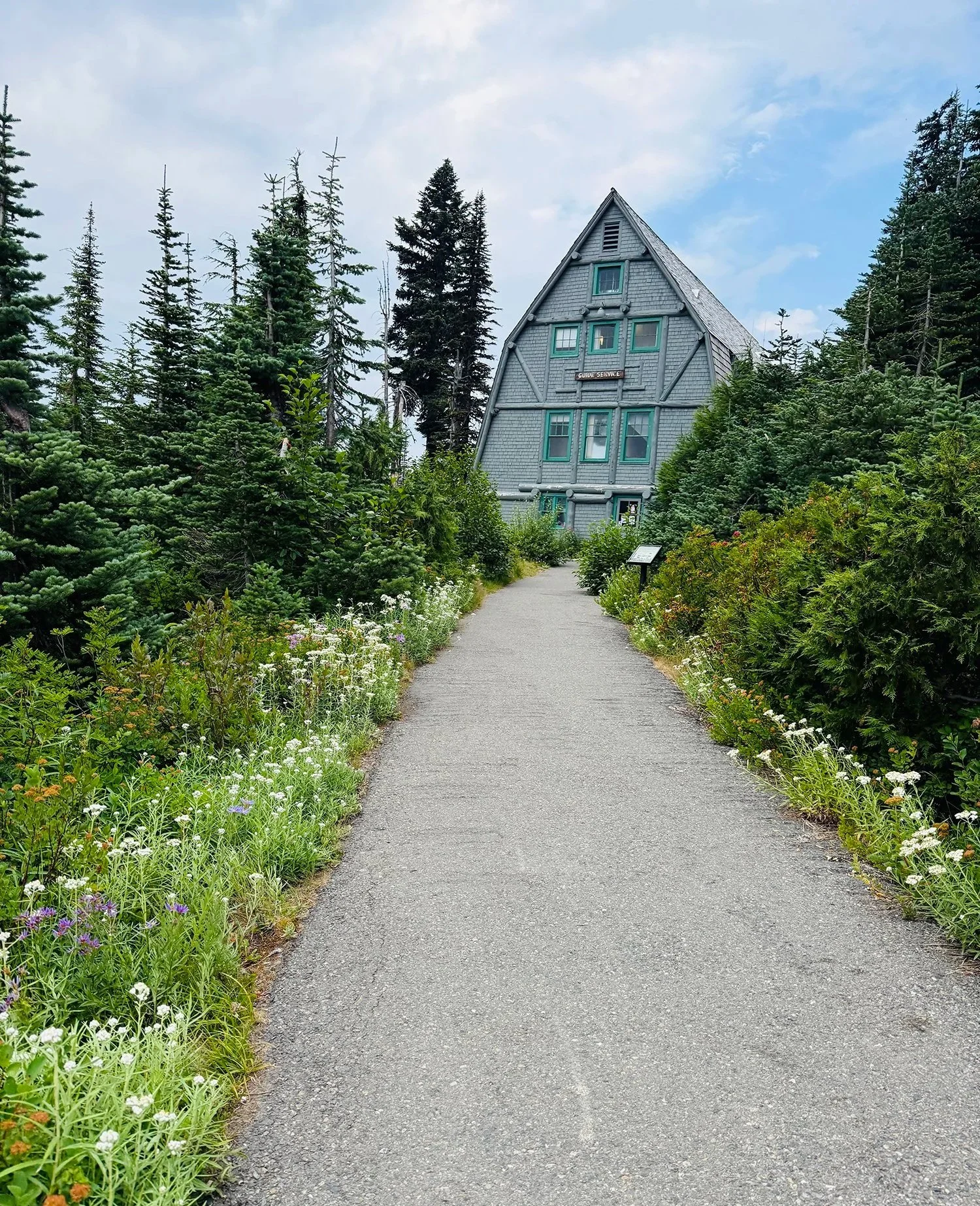
I had a great view of the Guide House, one of the historic 1920s structures in the park, so I decided to challenge myself to see how much I remembered from artist Carolyn Lord’s expert lessons on architectural perspective drawing. The mountain remained shrouded in heavy clouds, so I spent more time adding watercolor to my study of the Guide House. (I even remembered to capture a few seconds of video while I was painting—sorry for the shaky cam!)
People continued to flow through the area and every now and then someone would stop and ask if they could watch me paint, or to chat about art techniques.
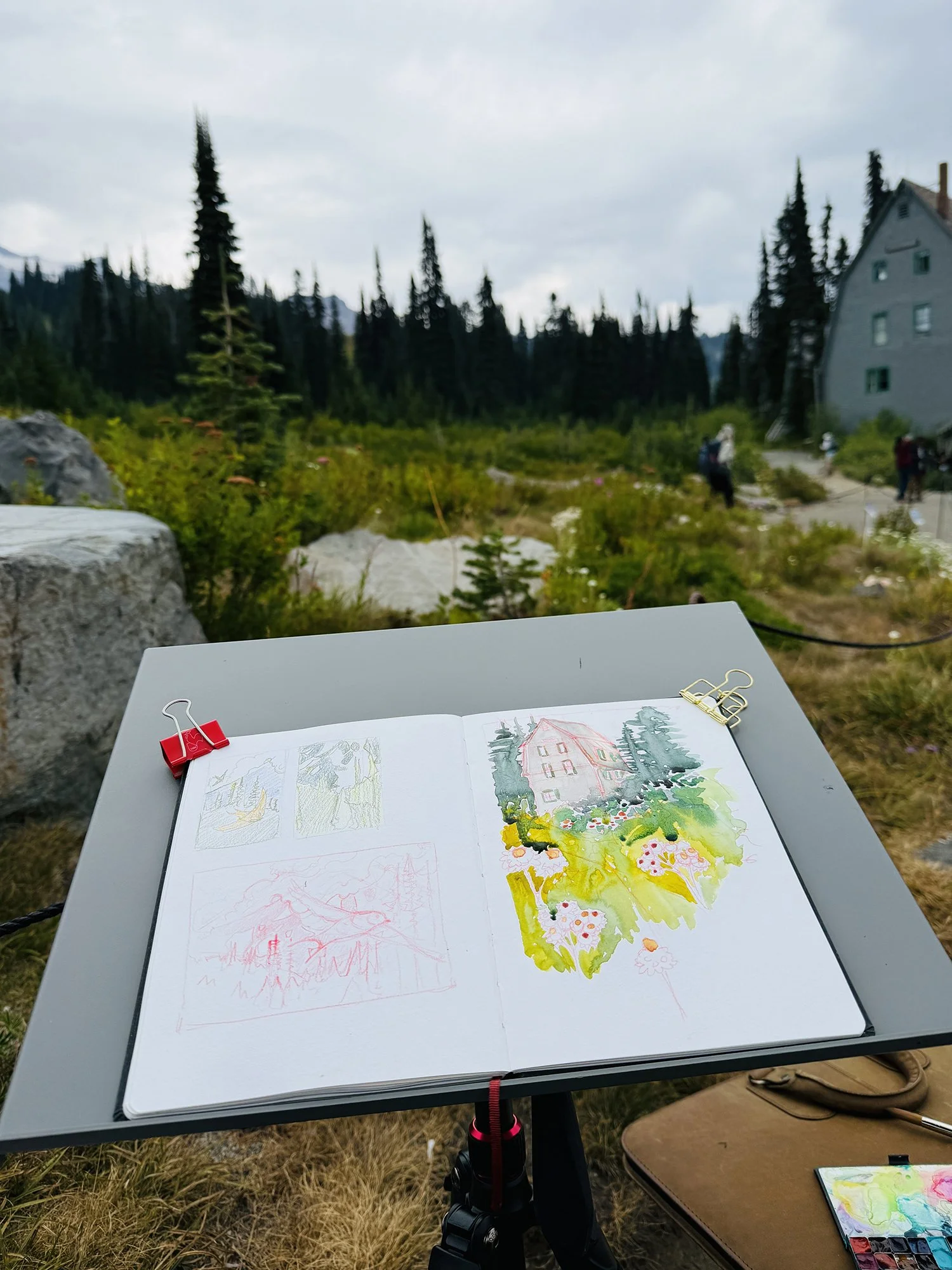
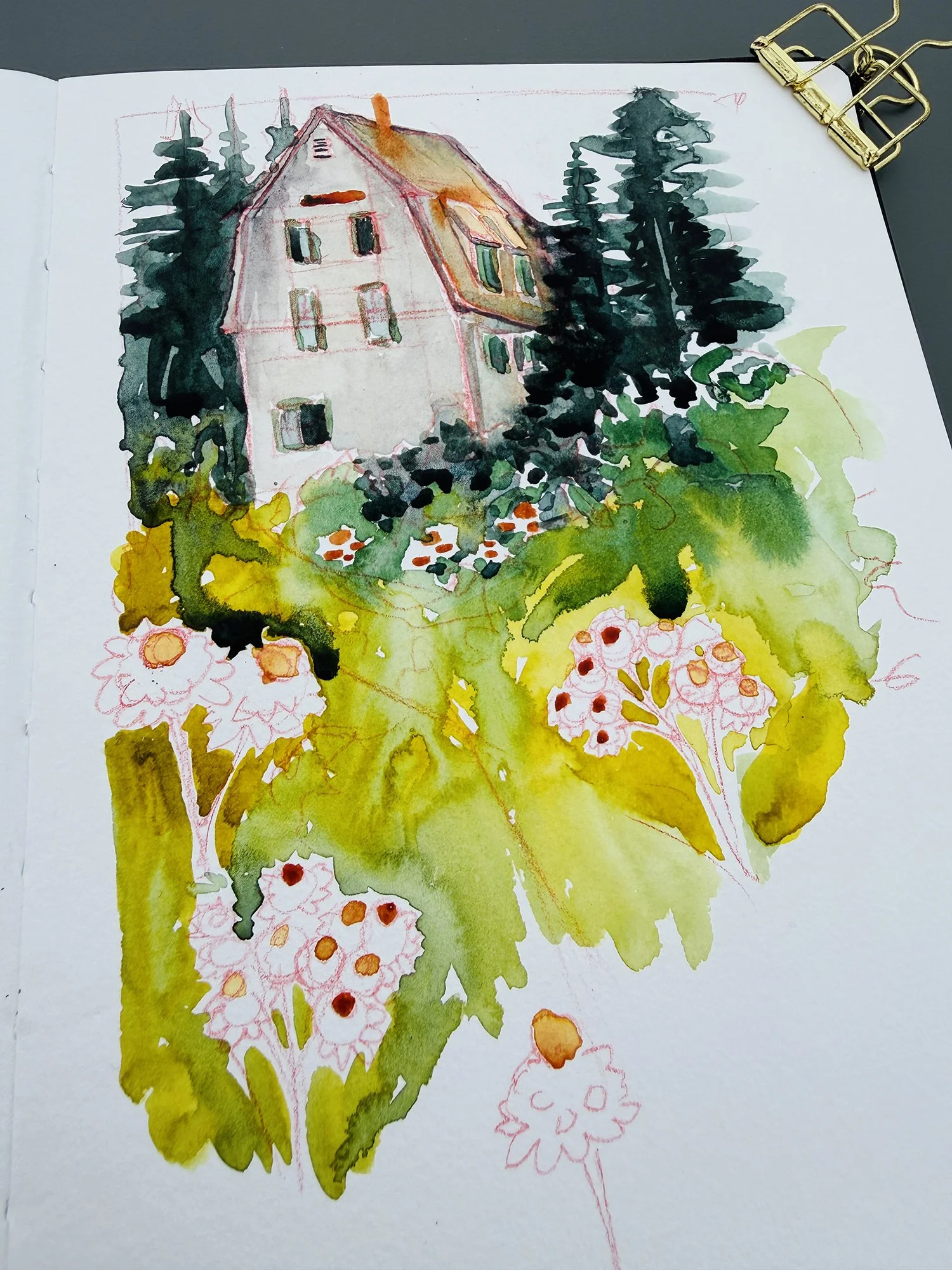
Watch me place a single, precious brushtroke of QoR Green Gold on the paper. I really love this color, it feels very “summer in the PNW” to me.
Turn on the sound if you want to hear what the main hub of Paradise visitor area sounds like!
Enter: the Crowds
After a short break for lunch, I set up my easel and taped down a new piece of watercolor paper, ready to dive into a larger piece. I started to settle in to paint, hardly noticing the small crowds passing by and through. But as the afternoon wore on and the sun came out (but only above the other mountain ranges) and the tourists arrived en masse.
Tour bus after tour bus emptied out into the parking lot. There were summer camp teens on field trips. There were intergenerational family vacationers. There were coaches full of international tourists. I certainly can’t blame anyone for wanting to visit our favorite hometown volcano, but my dream of a peaceful nature refuge was absolutely dying.
But I’ve always been good at tuning out background noise when I need to focus on my art—and here was my opportunity to get even more practice at it.
Harmonizing with Watercolors
I started to block in the large areas of color, carefully considering how to mix the exact shade of shifting blue-then-purple-then-gray of the mountain before I realized I already had the perfect color in my palette: Daniel Smith’s Shadow Violet. This color is an exquisite mix of Viridian, Ultramarine, and Pyrrole Orange pigments. As the colors dry the heavier blue particles settle into the valleys of the watercolor paper’s surface, while the warm orange undertones float to the top, creating an unpredictable purple-gray color that mimics the geological textures of the mountain itself. Watercolor is at its best when you just suggest where it should go and then let the pigments do their thing.
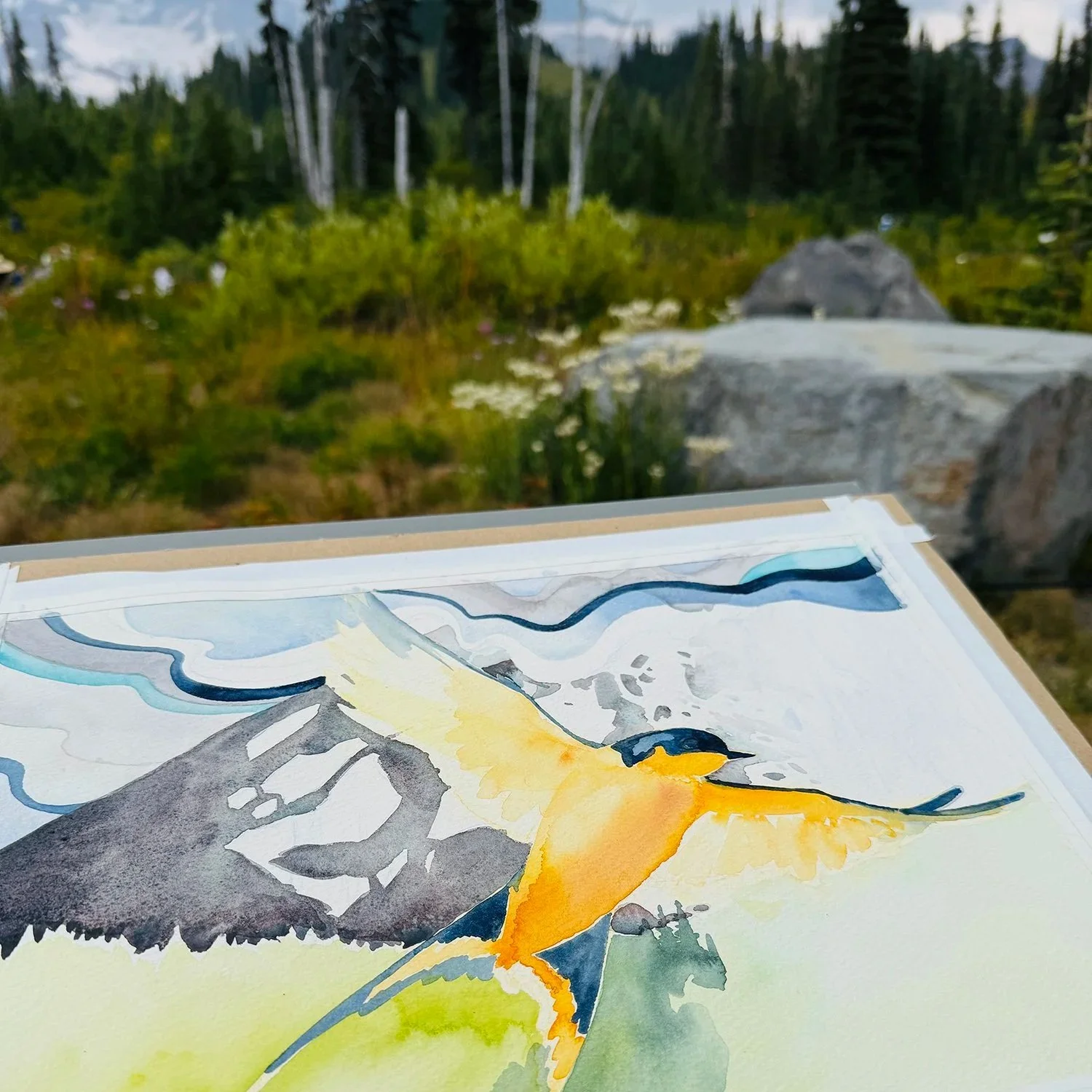
All the while, the persistent mist helpfully kept my paper damp. I sketched in the shapes of the barn swallow and dipped my brush into a rich ochre that perfectly matched the bird’s rufous belly and breast. As I moved on to the clouds and fog enrobing the mountain, the noise and crowds kept growing steadily. Out of the droning chatter rung out bright and clear, right next to me, a crying baby. Fortunately, they didn’t stay long.
I regrouped. What was I doing? Painting a cloud.
I let my paintbrush swoop across the page in flowing curves. Something about painting organic, curving shapes settles my nervous system. There’s nothing like the feeling of a long, flowing brushstroke that you can put your whole arm into, and it also has a compelling visual resonance. The right curves are just undeniably beautiful.
The Clash of Styles and Reality
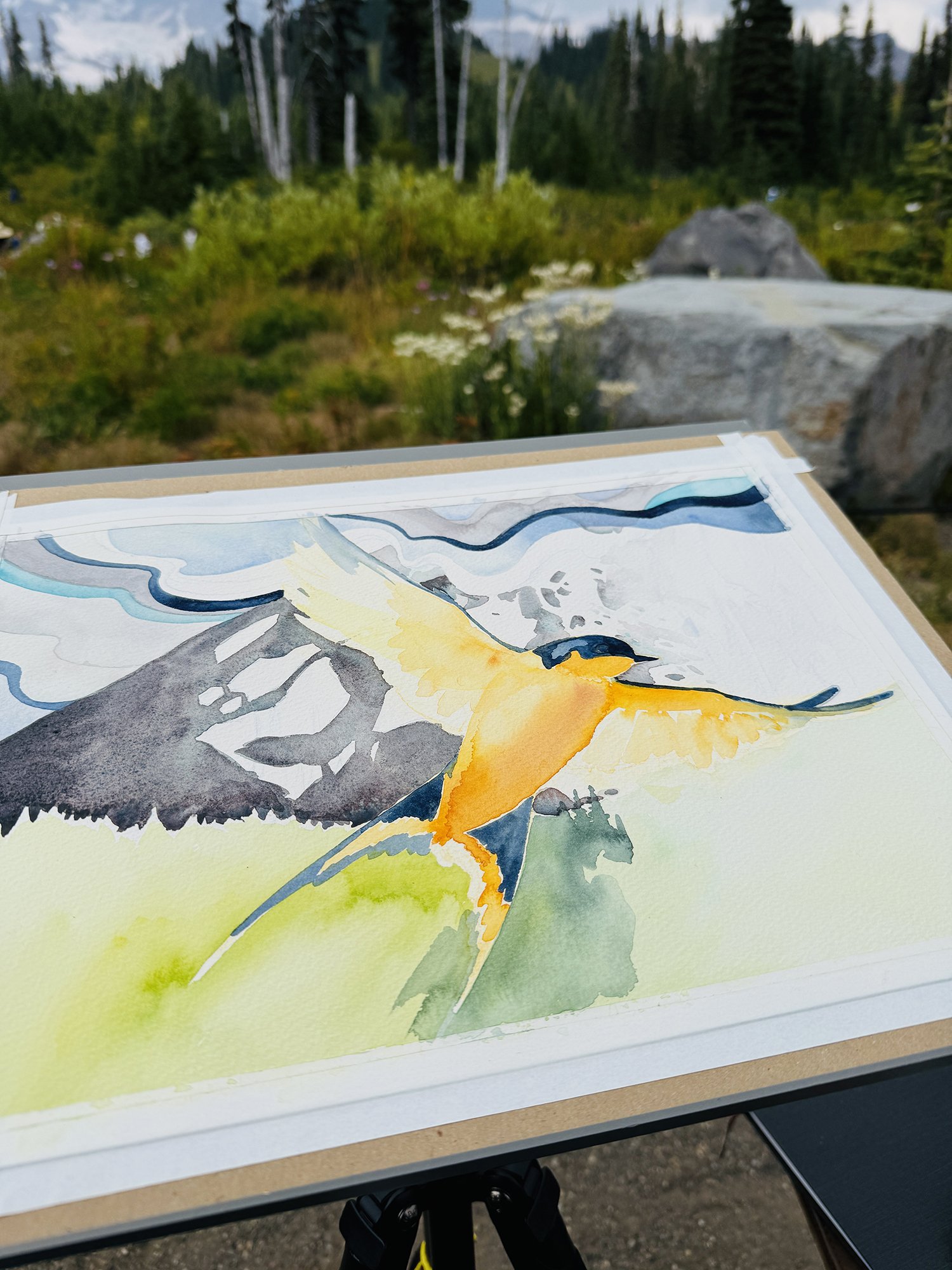
Once I’d painted the clouds, I was feeling restored. But then I noticed it. A problem. My styles were clashing. The curving clouds were a little too lyrical and stylized, while the mountain and the barn swallow were leaning more realistic. It was a mistake, but it wasn’t unsolvable. I just needed to add more ‘character’ to the shapes of the mountain and the glaciers.
I started to go back in with my beloved Shadow Violet and then…more crying. Plus the high-pitched shrieking of a small toddler. And they were parked right next to me with their mother and not going anywhere any time soon. I was trying so hard to focus. To lose myself in the painting. I hadn’t even brought my headphones because I had this magical dream being immersed in nature…not in a crowd of noisy tourists, car alarms, and all the reminders of the civilization I was trying to escape.
There has long been a romantic ideal of creating art out in nature. Plein air painting is meant to capture the immediacy of a moment in nature that will never exist again. Our most treasured natural landmarks have been recreated endless times in art, because every artist brings back something different from the experience.
I’m guessing those historic artists never had to dodge a stray selfie stick, but then again they probably also had to walk up that first 5000’ of elevation.
An Incomplete Masterpiece
My painting of the mountain is, as of typing this, still incomplete. While the screaming children couldn’t drive me off, the rain starting to come down in earnest was a good enough excuse to pack it in.
Maybe I’ll finish this painting in the studio, though I completely forgot to take a reference photo of the mountain because I was waiting for the clouds to move!
Maybe I’ll make another drive up to the mountain next year, earlier in the summer when all the most colorful wildflowers are in bloom. Definitely on a weekday, when the crowds are thinner. And maybe, by then, I’ll finally be able to hit the trails and find some artistic solitude in the wilderness.
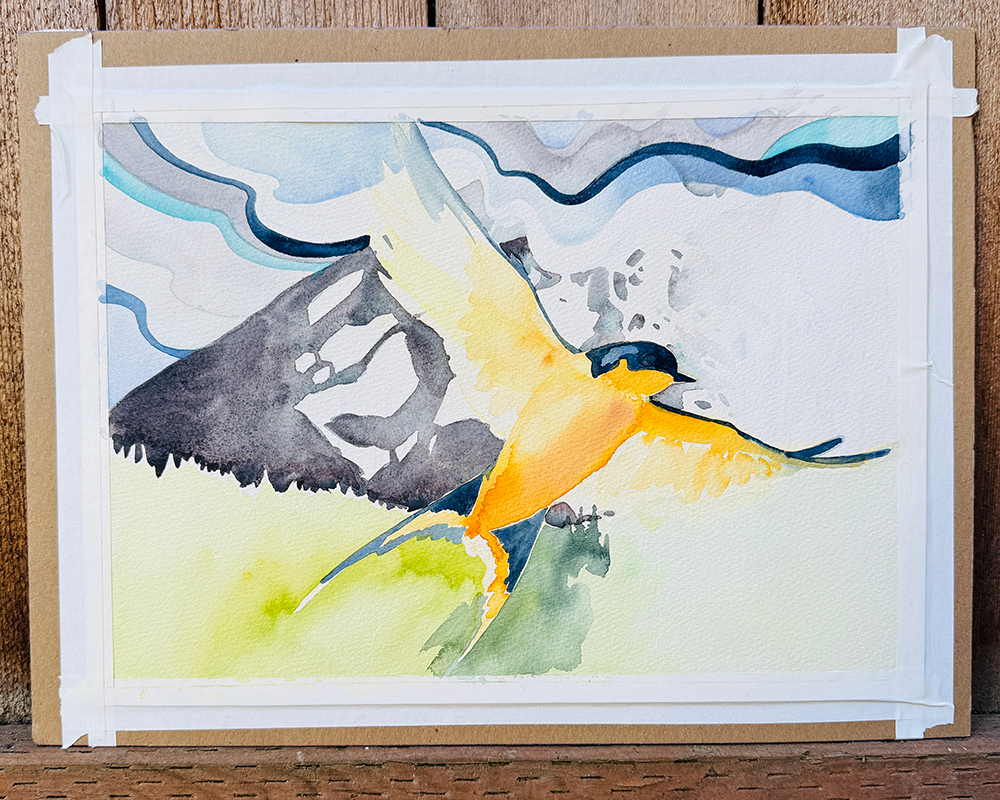
The current (and possibly final) state of my painting of the barn swallow and the cloud shrouded Mount Rainier.